
The Ugly Middle Stage: Jamie Kalvestran and the Chaos Before Clarity
“If I make a quilt out of this, my grandkids are going to be terrified to come to grandma’s house.”
Jamie Kalvestran stares at the hideous faces emerging from her work-in-progress—scary, distorted features that would send children running. It’s the ugly middle stage, that moment when most people abandon their work, convinced they’ve failed. But Kalvestran recognizes this place. She’s been here before in her painting, in her mixed media work, and in every creative endeavor that ultimately became something she loved. She keeps going.
What emerges is “Surviving Everything”—a quilt that now represents not just her artistic breakthrough but her entire teaching philosophy. Because the question isn’t whether you’ll hit the ugly middle stage. The question is whether you’ll trust yourself enough to work through it.
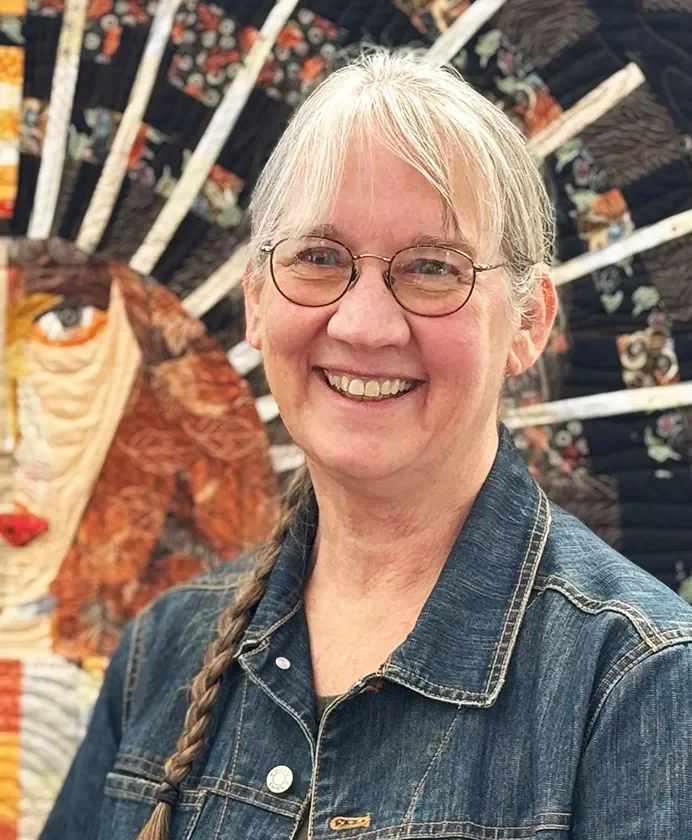
Jamie Kalvestran and one of her faces quilts
When the Universe Delivers Two-by-Fours
Kalvestran’s life reads like a masterclass in following intuition so completely that the universe rushes to meet her halfway.
There was the time she sat at her computer researching the price of lumber, shocked at how expensive two-by-fours had become. “How do people afford to do anything in today’s world?” she wondered. Minutes later—honk, honk, honk—her elderly neighbor pulled up asking if she needed any two-by-fours. He drove her to his workshop, found the wood behind some tires, and handed it all over for free.
“Anytime I start to doubt myself or worry about the future, I remind myself of that experience,” she explains.
But this ease didn’t come from drift or luck. It came from a woman willing to walk away from a VP position at a credit union in the 1980s—when making money was the cultural imperative—because she hated her job and wanted to be like the graphic designers who showed up to lunch in jeans instead of polyester pantsuits.
She sold everything, applied to Minneapolis College of Art and Design, and discovered product design. The work followed: Tonka Toys, Manhattan Toy, Rollerblade, and a string of freelance clients. She designed patterns that became top-ten sellers. She landed a fabric design contract at her very first Quilt Market, standing in her half-booth while Checker distributor—the biggest in the industry—picked up her work. Andover Fabrics approached her during that same show.
Things that take others years of struggle happened for Kalvestran with startling speed. Not because she didn’t work—she absolutely did—but because she coupled relentless effort with equally relentless trust in her instincts.
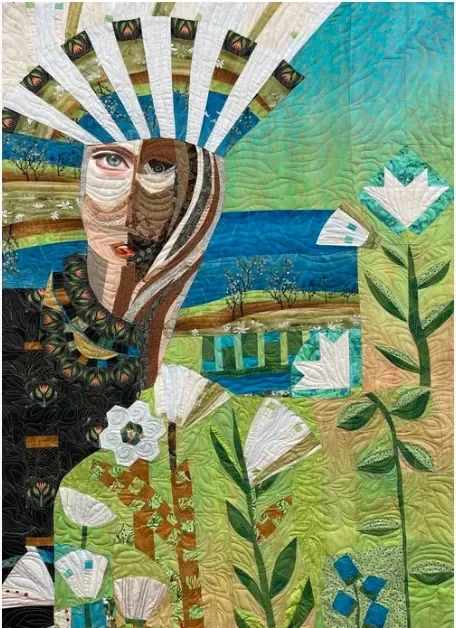
Tender and Fierce Quilt by Jamie Kalvestran
The Philosophy Between Technical Skill and Creativity
When the quilt industry shifted and free downloads flooded the market, when her marriage ended and her income dropped dramatically, Kalvestran made another choice: She would prioritize lifestyle over money. She kept one retainer client who paid the bills—Yonder Horse, designing saddle blankets and cowgirl accessories—and stopped striving.
In January 2024, at 68 years old, she looked at her expensive bottles of acrylic paint and thought: This isn’t sustainable. Her gaze fell on her fabric collection—years of her own designs covering her palette. What if she could create quilts that gave her the same freedom and joy as her other art?
She signed up for Maria Shell’s “Stitching Toward Discovery,” a six-month online course not about technique replication but voice discovery. Five or six quilts later, Kalvestran had found her answer—and in the process developed the philosophy that now anchors her teaching. Technical skill, she explains, is one thing—you can be so good at it that you become a forger, able to recreate the Mona Lisa, but that doesn’t make you creative. On the opposite end sits pure creativity without technical skill, the realm of outsider artists. Most people land somewhere in between.
Then there’s the distinction between design and art. Design solves problems within constraints—colors chosen, constraints established, puzzle pieces assembled. Art begins with not knowing. “I put a canvas on the wall, I start adding things, and I turn it and turn it and keep adding. Eventually something comes through, and I know where it’s going. That process gives me the most joy.”
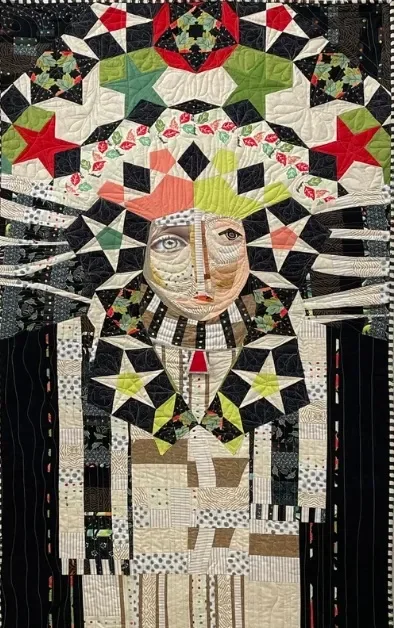
Ennobled Quilt by Jamie Kalvestran
When Alex Anderson Points Her Finger
Kalvestran didn’t intend to become a teacher. When Alex Anderson from The Quilt Showdiscovered her work on Facebook and invited her on the show, Kalvestran panicked. Anderson literally pointed her finger through the screen: “Jamie Kalvestran, I want to learn from you. And if I want to learn from you, other people want to learn from you.”
The problem was Kalvestran had no idea what she was doing, let alone how to teach it. Fortune intervened—her father was dying, and she missed the Quilt Show taping. The producer moved her back six months, time Kalvestran needed to figure out not just what she’d teach, but whether she could teach at all. Because the word “teacher” didn’t fit. But “inspire”? That resonated.
“I’m comfortable putting myself in a situation with a whole bunch of people for a weekend or five days and working side by side with them,” she realized. “I’m all about inspiring people to grow their creativity. It’s not to teach them how to do something specific. It’s to set people up to have the experience I had where you can find your voice in what you’re doing. And then what happens is you find you.”
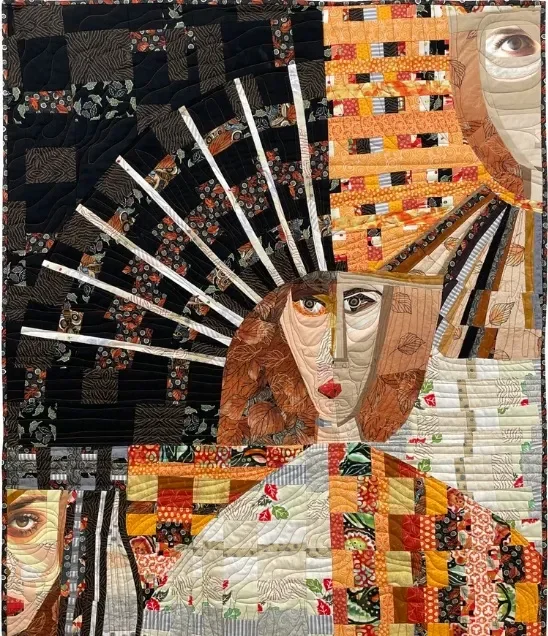
Surviving Everything Quilt by Jamie Kalvestran
The Method Behind the Freedom
The “Quilt Like an Artist“approach that Kalvestran brings to the Estelle Center this July isn’t about replicating her work. It’s about accessing your own creative voice through faces and figures—subject matter that feels simultaneously universal and intimidatingly personal.
Students begin with experiments and playful exploration, building confidence before diving into the technical challenges. They learn to start with an eye—sometimes photographic, sometimes pieced—then let the face emerge improvisationally. “I have no idea in my head what it’s going to look like,” Kalvestran says. “You make the eye, and then you try things around it, and you’re like, oh, that’s kind of fun!”
She teaches two methods: folded foundation paper piecing on one side of the face, completely improvisational work on the other. The contrast itself becomes instructive—showing that technical precision and creative freedom aren’t opposites but partners.
In test workshops, her feedback was consistent. Traditional perfectionists found it challenging but not for them—which is fine. Experienced quilters who weren’t perfection-focused responded with revelation: “I’ve been quilting for 10 years. I didn’t know you could do that.” And people new to quilting? They were all in, unburdened by rules they’d never learned.
An Invitation to Discover
When Kalvestran teaches her first in-person retreat this summer, she’ll be leaping into her own version of not knowing—trusting the process she advocates, working through her own ugly middle stage for the first time in front of a group. But that’s exactly the point.
"Everybody’s going to be doing the same process, but everybody’s going to produce something really different," she explains. "And I want people to respect the process and what it can show them. "
Come to the Estelle Center prepared not for perfection, but for that experience of hitting the ugly stage and, crucially, keeping going until you discover work that reflects not what you think art should be, but who you actually are.
Jamie Kalvestran's "Quilt Like an Artist: Faces & Figures" retreat runs July 20-24, 2026, with a second session July 27-31 (waitlist only). It’s an opportunity to create the kind of quilts that might terrify your grandchildren in their rough stages—and become your proudest work by the end.
Click below to learn more about Jamie Kalvestran's Quilt Like An Artist: Faces & Figures retreat at the Estelle Center.
Marilyn Heywood Paige is the marketing director for the Estelle Center and an award-winning logo designer and content creator. She posts about junk journaling and making greeting cards on the Estelle Facebook and Instagram pages.